AD 2011-18-01
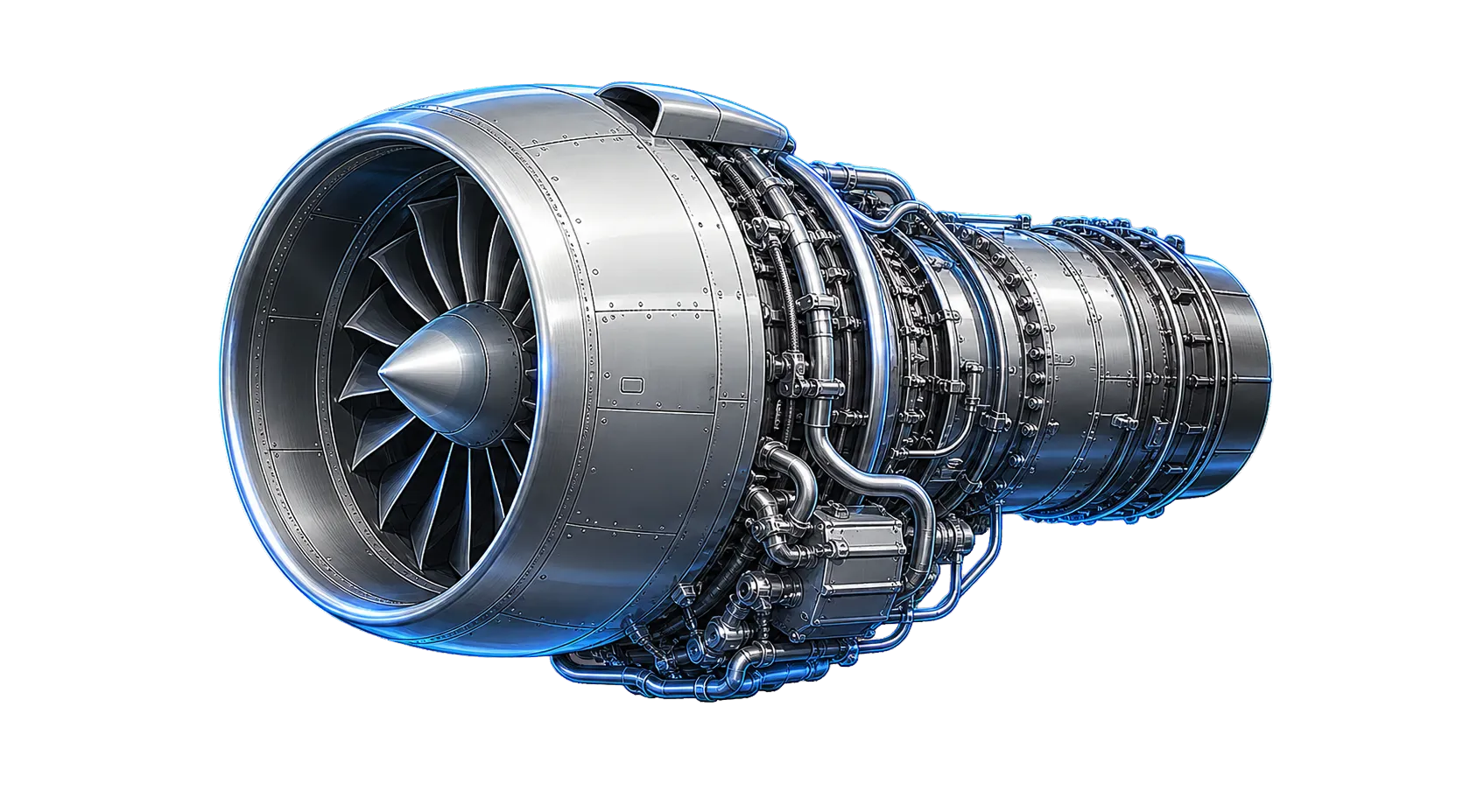
Applicability
| Type | Manufacturer | Model | Details |
|---|---|---|---|
| aircraft | General | CF6-45 CF6-50 | Airworthiness Directives; General Electric Company (GE) CF6-45 Series and CF6-50 Series Turbofan Engines |
Unsafe Condition
Reports of uncontained failures and cracked low-pressure turbine (LPT) rotor stage 3 disks during shop visit inspections indicate a potential for LPT rotor separation, which could result in an uncontained engine failure and damage to the airplane.
AI-generated summary from the source AD text. Verify against the official source before acting.
Required Actions
At the next shop visit after the effective date, clean and fluorescent penetrant inspect the LPT rotor stage 3 disk forward spacer arm, including the use of a wet abrasive blast to eliminate residual or background fluorescence before inspecting. Thereafter, repeat the inspection at each engine shop visit that occurs after 1,000 cycles since the last FPI of the LPT rotor stage 3 disk forward spacer arm.
AI-generated summary from the source AD text. Verify against the official source before acting.
Compliance Time
Within the next shop visit after the effective date of the AD.
AI-generated summary from the source AD text. Verify against the official source before acting.
Affected Aircraft
General Electric Company (GE) CF6-45 Series and CF6-50 Series Turbofan Engines.
AI-generated summary from the source AD text. Verify against the official source before acting.
Federal Register Abstract
We are adopting a new airworthiness directive (AD) for the products listed above. This AD requires performing a fluorescent penetrant inspection (FPI) of the low-pressure turbine (LPT) rotor stage 3 disk at every shop visit at which the LPT module is separated from the engine. This AD was prompted by seven reports of uncontained failures of LPT rotor stage 3 disks and eight reports of cracked LPT rotor stage 3 disks found during shop visit inspections. We are issuing this AD to prevent LPT rotor separation, which could result in an uncontained engine failure and damage to the airplane.
Document Text
Show stored source text (verify against official source)
[Federal Register Volume 76, Number 162 (Monday, August 22, 2011)]
[Rules and Regulations]
[Pages 52213-52215]
From the Federal Register Online via the Government Publishing Office [<a href="http://www.gpo.gov">www.gpo.gov</a>]
[FR Doc No: 2011-21312]
========================================================================
Rules and Regulations
Federal Register
________________________________________________________________________
This section of the FEDERAL REGISTER contains regulatory documents
having general applicability and legal effect, most of which are keyed
to and codified in the Code of Federal Regulations, which is published
under 50 titles pursuant to 44 U.S.C. 1510.
The Code of Federal Regulations is sold by the Superintendent of Documents.
Prices of new books are listed in the first FEDERAL REGISTER issue of each
week.
========================================================================
Federal Register / Vol. 76, No. 162 / Monday, August 22, 2011 / Rules
and Regulations
[[Page 52213]]
=======================================================================
-----------------------------------------------------------------------
DEPARTMENT OF TRANSPORTATION
Federal Aviation Administration
14 CFR Part 39
[Docket No. FAA-2010-0998; Directorate Identifier 2010-NE-29-AD;
Amendment 39-16783; AD 2011-18-01]
RIN 2120-AA64
Airworthiness Directives; General Electric Company (GE) CF6-45
Series and CF6-50 Series Turbofan Engines
AGENCY: Federal Aviation Administration (FAA), DOT.
ACTION: Final rule.
-----------------------------------------------------------------------
SUMMARY: We are adopting a new airworthiness directive (AD) for the
products listed above. This AD requires performing a fluorescent
penetrant inspection (FPI) of the low-pressure turbine (LPT) rotor
stage 3 disk at every shop visit at which the LPT module is separated
from the engine. This AD was prompted by seven reports of uncontained
failures of LPT rotor stage 3 disks and eight reports of cracked LPT
rotor stage 3 disks found during shop visit inspections. We are issuing
this AD to prevent LPT rotor separation, which could result in an
uncontained engine failure and damage to the airplane.
DATES: This AD is effective September 26, 2011.
ADDRESSES: You may examine the AD docket on the Internet at <a href="http://www.regulations.gov">http://www.regulations.gov</a>; or in person at the Docket Management Facility
between 9 a.m. and 5 p.m., Monday through Friday, except Federal
holidays. The AD docket contains this AD, the regulatory evaluation,
any comments received, and other information. The address for the
Docket Office (phone: 800-647-5527) is Document Management Facility,
U.S. Department of Transportation, Docket Operations, M-30, West
Building Ground Floor, Room W12-140, 1200 New Jersey Avenue, SE.,
Washington, DC 20590.
FOR FURTHER INFORMATION CONTACT: Tomasz Rakowski, Aerospace Engineer,
Engine Certification Office, FAA, Engine & Propeller Directorate, 12
New England Executive Park, Burlington, MA 01803; phone: (781) 238-
7735; fax: (781) 238-7199; e-mail: <a href="/cdn-cgi/l/email-protection#74001b1915070e5a06151f1b03071f1d341215155a131b02"><span class="__cf_email__" data-cfemail="7c0813111d0f06520e1d17130b0f17153c1a1d1d521b130a">[email protected]</span></a>.
SUPPLEMENTARY INFORMATION:
Discussion
We issued a notice of proposed rulemaking (NPRM) to amend 14 CFR
part 39 to include an airworthiness directive (AD) that would apply to
the specified products. That NPRM published in the Federal Register on
October 20, 2010, (75 FR 64681). That NPRM proposed to require
performing a fluorescent penetrant inspection at every shop visit when
the LPT module assembly is separated from the engine.
Comments
We gave the public the opportunity to participate in developing
this AD. The following presents the comments received on the proposal
and the FAA's response to each comment.
Support for the NPRM as Written
Two commenters, the National Transportation Safety Board and The
Boeing Company support the NPRM as written.
Request To Define LPT Module
Two commenters, GE and MTU Maintenance Canada, asked us to define
``LPT module.'' The commenters feel the term LPT module could be
confused with the LPT rotor assembly.
We agree. We changed paragraph (e) of the proposed AD to clarify
that the intent of this AD is to inspect the LPT rotor stage 3 disk
when the LPT module assembly separates from the engine for maintenance,
and added new paragraphs (i) and (i)(1) that define the LPT module
assembly.
Request To Require Only Conditional Inspection
One commenter, MTU Maintenance Canada, asked us to change the
compliance time for the inspection. MTU stated the proposed AD requires
stage 3 disk FPI at piece-part level regardless of the part utilization
(cycles-since-last inspection) or operational history since the last
inspection. MTU asked us to change the inspection to the next time the
LPT module assembly is disassembled to piece-part level for certain
engine conditions only.
We don't agree with the request for conditional inspections only.
The intent of this AD is to require an FPI of the LPT rotor stage 3
disk forward spacer arm at each shop visit where the LPT module
assembly is separated in a cyclic manner, regardless of the reason for
the separation. The requirements for conditional piece-part FPI are
already mandated by AD 2011-02-07. We didn't change the AD.
Request To Add Conditional Inspection
One commenter, Evergreen International Airlines, asked us to
additionally require the inspection if the engine encountered excessive
core vibration, or HPT blade separation or excessive material loss, or
unserviceable LPT blade interlock wear, in addition to the repetitive
inspections proposed in the NPRM.
We don't agree. The requirements for conditional piece-part FPI are
already mandated by AD 2011-02-07. We didn't change the AD.
Request To Change the Compliance Time for the Inspection
One commenter, Evergreen International Airlines, asked us to
require inspections if the LPT rotor stage 3 disk hasn't been FPI
inspected within the last 2,000 cycles or at all. Evergreen stated the
separation of the LPT module is required when the maintenance of
certain HPC, combustor, and HPT assemblies and parts need to be
performed. Engines removed for maintenance of those components would
require LPT rotor stage 3 disk cleaning and FPI regardless of the time
interval since the last FPI per the proposed AD, which would be an
unnecessary burden on the operators.
We partially agree. We agree with the request for a certain number
of cycles since the last FPI to exclude the part from mandatory
inspection. However, we do not find the number of 2,000 cycles since
last inspection (CSLI) appropriate to ensure a desired level of safety.
We find that an acceptable level of safety will be retained when the
disk FPI inspection is skipped during the shop visit if the disk was
inspected within the last 1,000 cycles. We changed paragraphs (f) and
(g) to ``(f) At the next shop visit after the effective date of this
AD, clean and fluorescent
[[Page 52214]]
penetrant inspect the LPT rotor stage 3 disk forward spacer arm,
including the use of a wet abrasive blast to eliminate residual or
background fluorescence before inspecting. You can find guidance on
cleaning the disk and performing the FPI in the CF6-50 Engine Manual,
GEK 50481 72-57-02.'' and ``(g) Thereafter, clean and inspect the LPT
rotor stage 3 disk forward spacer arm, as specified in paragraph (f),
at each engine shop visit that occurs after 1,000 cycles since the last
FPI of the LPT rotor stage 3 disk forward spacer arm.'' We also added
paragraphs (i) and (i)(2) that define an engine shop visit as follows:
``An engine shop visit is the induction of an engine into the shop for
maintenance involving the separation of the turbine mid-frame forward
flange from the compressor rear frame aft flange, except that the
separation of these engine flanges solely for the purposes of
transportation without subsequent engine maintenance does not
constitute an engine shop visit.''
Request To Change the Type of Inspection
One commenter, GE, asked us to consider changing the type of
inspection from FPI to ultrasonic inspection (USI). GE stated that they
have developed a USI technique and tooling which allow inspecting the
LPT rotor stage 3 disk forward spacer arm without piece part
disassembly of the LPT. Implementing the USI will detect cracks in the
forward spacer arm, which might propagate during operation and would be
a suitable alternative to the piece-part disassembly, cleaning, and FPI
of the forward spacer arm in many situations.
We don't agree. We don't believe USI technique specified in GE SB
CF6-50 S/B 72-1309 is a sufficient means of detecting flaws or
microcracks on the inner surface of the LPT rotor stage 3 disk forward
spacer arm. Paragraph E.(5) of SB CF6-50 S/B 72-1309 states ``The new
USI probe was specifically designed to detect flaws 0.030 inch (0.76
mm) deep or greater in the forward spacer arm of the stage 3 LPTR
disk.'' We find that a 0.030-inch deep surface crack size is
unacceptable in that location, as it would have already propagated in a
high-cycle fatigue mode. The intent of this AD is to detect cracks
before they propagate. We made no change to the proposed AD.
Request To Change the Costs of Compliance
Two commenters, MTU Canada and FedEx, asked us to re-evaluate the
Costs of Compliance for the actions required by the proposed AD. The
commenters state that cleaning the stage 3 disk and performing an FPI
are done at the piece-part level, and that the costs of disassembling
and reassembling the LPT module assembly, and of the inspections
required by the engine manual for reinstalling the stage 3 blades must
be added to the cost of cleaning and inspecting the disk.
We don't agree. Our estimated cost is the direct cost to comply
with the AD, and doesn't include preparatory disassembly or
reinstallation. We didn't change the AD.
Request To Change Paragraph (f) of the Proposed AD
One commenter, GE, asked us to change paragraph (f) of the proposed
AD to use the words ``including the use of'' in place of the word
``using'', where cleaning the LPT rotor stage 3 disk with wet-abrasive
blast to eliminate residual or background fluorescence is required. GE
doesn't consider a wet-abrasive blast alone sufficient to clean the LPT
rotor stage 3 disk to allow performance of the FPI of the inner
diameter of the forward cone body of the LPT rotor stage 3 disk.
We agree. We changed paragraph (f) of the proposed AD from ``Clean
the LPT rotor stage 3 disk, using a wet abrasive blast to eliminate
residual or background fluorescence. You can find guidance on cleaning
the disk in the cleaning procedure of CF6-50 Engine Manual, GEK 50481
72-57-02.'' to ``At the next engine shop visit after the effective date
of this AD, clean and fluorescent-penetrant inspect the LPT rotor stage
3 disk forward spacer arm, including the use of a wet-abrasive blast to
eliminate residual or background fluorescence before inspecting. You
can find guidance on cleaning the disk and performing the FPI in the
CF6-50 Engine Manual, GEK 50481 72-57-02.''
Request To Include Definitions for Cleaning and FPI of the LPT Rotor
Stage 3 Disk
One commenter, Evergreen International Airlines, asked us to add
definitions of ``cleaning the LPT rotor stage 3 disk'' and ``FPI of the
LPT rotor stage 3 disk,'' with specific engine manual subtask
references, to the proposed AD. The commenter states that the
definitions will clarify the actions required by the proposed AD.
We don't agree. The reference provided in the proposed AD is
sufficient to define the required actions. We made no changes to the
proposed AD.
Conclusion
We reviewed the relevant data, considered the comments received,
and determined that air safety and the public interest require adopting
the AD with the changes described previously.
We also determined that these changes will not increase the
economic burden on any operator or increase the scope of the AD.
Costs of Compliance
We estimate that this AD will affect 387 engines installed on
airplanes of U.S. registry. We also estimate that it will take about 7
work-hours per engine to clean and FPI the disk 387 engines. The
average labor rate is $85 per work-hour. No parts will be required.
Based on these figures, we estimate the total cost of the AD to U.S.
operators to be $230,265.
Authority for This Rulemaking
Title 49 of the United States Code specifies the FAA's authority to
issue rules on aviation safety. Subtitle I, section 106, describes the
authority of the FAA Administrator. Subtitle VII: Aviation Programs,
describes in more detail the scope of the Agency's authority.
We are issuing this rulemaking under the authority described in
Subtitle VII, Part A, Subpart III, Section 44701: ``General
requirements.'' Under that section, Congress charges the FAA with
promoting safe flight of civil aircraft in air commerce by prescribing
regulations for practices, methods, and procedures the Administrator
finds necessary for safety in air commerce. This regulation is within
the scope of that authority because it addresses an unsafe condition
that is likely to exist or develop on products identified in this
rulemaking action.
Regulatory Findings
This AD will not have federalism implications under Executive Order
13132. This AD will not have a substantial direct effect on the States,
on the relationship between the national government and the States, or
on the distribution of power and responsibilities among the various
levels of government.
For the reasons discussed above, I certify that this AD:
(1) Is not a ``significant regulatory action'' under Executive
Order 12866,
(2) Is not a ``significant rule'' under DOT Regulatory Policies and
Procedures (44 FR 11034, February 26, 1979),
(3) Will not affect intrastate aviation in Alaska, and
(4) Will not have a significant economic impact, positive or
negative, on a substantial number of small entities under the criteria
of the Regulatory Flexibility Act.
[[Page 52215]]
List of Subjects in 14 CFR Part 39
Air transportation, Aircraft, Aviation safety, Incorporation by
reference, Safety.
Adoption of the Amendment
Accordingly, under the authority delegated to me by the
Administrator, the FAA amends 14 CFR part 39 as follows:
PART 39--AIRWORTHINESS DIRECTIVES
0
1. The authority citation for part 39 continues to read as follows:
Authority: 49 U.S.C. 106(g), 40113, 44701.
Sec. 39.13 [Amended]
0
2. The FAA amends Sec. 39.13 by adding the following new airworthiness
directive (AD):
2011-18-01 General Electric Company: Amendment 39-16783; Docket No.
FAA-2010-0998; Directorate Identifier 2010-NE-29-AD.
Effective Date
(a) This AD is effective September 26, 2011.
Affected ADs
(b) None.
Applicability
(c) This AD applies to General Electric Company (GE) CF6-45A,
CF6-45A2, CF6-50A, CF6-50C, CF6-50CA, CF6-50C1, CF6-50C2, CF6-50C2B,
CF6-50C2D, CF6-50E, CF6-50E1, and CF6-50E2 series turbofan engines,
including engines marked on the engine data plate as CF6-50C2-F and
CF6-50C2-R, with a low-pressure turbine (LPT) rotor stage 3 disk
that has a part number (P/N) listed in Table 1 of this AD installed.
Table 1--LPT Rotor Stage 3 Disk P/Ns
------------------------------------------------------------------------
------------------------------------------------------------------------
1473M90P01 1473M90P02 1473M90P03 1473M90P04
1479M75P01 1479M75P02 1479M75P03 1479M75P04
1479M75P05 1479M75P06 1479M75P07 1479M75P08
1479M75P09 1479M75P11 1479M75P13 1479M75P14
9061M23P06 9061M23P07 9061M23P08 9061M23P09
9061M23P10 9061M23P12 9061M23P14 9061M23P15
9061M23P16 9224M75P01 ................ ................
------------------------------------------------------------------------
Unsafe Condition
(d) This AD results from seven reports of uncontained failures
of LPT rotor stage 3 disks and eight reports of cracked LPT rotor
stage 3 disks found during shop visit inspections. We are issuing
this AD to prevent LPT rotor separation, which could result in an
uncontained engine failure and damage to the airplane.
Compliance
(e) You are responsible for having the actions required by this
AD performed at each shop visit after the effective date of this AD,
at which the LPT module assembly is separated from the engine.
Initial Inspection
(f) At the next shop visit after the effective date of this AD,
clean and fluorescent-penetrant inspect the LPT rotor stage 3 disk
forward spacer arm, including the use of a wet-abrasive blast to
eliminate residual or background fluorescence before inspecting. You
can find guidance on cleaning the disk and performing the FPI in the
CF6-50 Engine Manual, GEK 50481 72-57-02.
Repetitive Inspection
(g) Thereafter, clean and inspect the LPT rotor stage 3 disk
forward spacer arm, as specified in paragraph (f) of this AD, at
each engine shop visit that occurs after 1,000 cycles since the last
FPI of the LPT rotor stage 3 disk forward spacer arm.
(h) If a crack or a band of fluorescence is present, remove the
disk from service.
Definitions
(i) For the purpose of this AD:
(1) The LPT module assembly is defined as consisting of turbine
mid-frame, LPT stage 1 nozzle, LPT stator cases and vanes, LPT
rotor, and turbine rear frame.
(2) An engine shop visit is the induction of an engine into the
shop for maintenance involving the separation of the turbine mid-
frame forward flange from the compressor rear frame aft flange,
except that the separation of these engine flanges solely for the
purposes of transportation without subsequent engine maintenance
does not constitute an engine shop visit.
Alternative Methods of Compliance
(j) The Manager, Engine Certification Office, has the authority
to approve alternative methods of compliance for this AD if
requested using the procedures found in 14 CFR 39.19.
Related Information
(k) For more information about this AD, contact Tomasz Rakowski,
Aerospace Engineer, Engine Certification Office, FAA, Engine &
Propeller Directorate, 12 New England Executive Park, Burlington, MA
01803; phone: (781) 238-7735; fax: (781) 238-7199; e-mail:
<a href="/cdn-cgi/l/email-protection#e89c8785899b92c69a8983879f9b8381a88e8989c68f879e"><span class="__cf_email__" data-cfemail="a7d3c8cac6d4dd89d5c6ccc8d0d4cccee7c1c6c689c0c8d1">[email protected]</span></a>.
Material Incorporated by Reference
(l) None.
Issued in Burlington, Massachusetts on August 15, 2011.
Peter A. White,
Manager, Engine & Propeller Directorate, Aircraft Certification
Service.
[FR Doc. 2011-21312 Filed 8-19-11; 8:45 am]
BILLING CODE 4910-13-P
Source: Official FAA Source ↗
Retrieved: Apr 6, 2026
Rights: U.S. Government Public Domain
This site is not affiliated with or endorsed by the FAA. Always verify with official sources.
Related Airworthiness Directives
Amdt-39-9186 Recurring
final ruleAirworthiness Directives; General Electric Company (GE) CF6-45 and CF6-50 Series Turbofan Engines
Unsafe Condition: HPC rear shaft fracture could result in inflight engine shutdown and uncontained engine failure.